
5. Breaking Thru
Being honest means first being honest with yourself

Zoya took it well…perhaps too well. She was SO calm.
I absolutely did not expect hysterics or shouting, but I thought she might be giddy at the news that we were now filthy, stinking rich. I should have known better, but my radar on Zoya’s feelings and reactions has always been a bit unreliable despite many years of marriage.
We were drinking tea in the kitchen. She was eating toast and I explained to her that I was going to work on a late train today because I had some big news I needed to share with her.

Zoya looked at me warily. She is ever suspicious of “big news” or tidings of any kind.
I told her about the day before just as I recently related it to you dear reader. Looking back, I’m proud of myself that I did not lie or embellish any of it.
I described my reaction. I told her about the trust arrangement and the lawyer, emphasizing that none of the things I had done were set in stone. “I’ve just asked him to draw up a trust plan and hold onto the ticket for now. Nothing is decided until we go and talk to him together.”
Her first question was predictable, “How much did you say the ticket was for?” I told her again. She nodded with a little smile on her face and said, “That’s amazing. How can you be sure we will actually receive this money? Won’t the lawyer keep the ticket and claim it for himself?”
I explained to her how I had protected us from that circumstance by signing and copying the ticket, having all the paperwork signed, notarized and sent to us in the mail, and also by taking a copy home for us. I produced the papers from my work bag and showed them to her.
Her delicate, long-fingered hands moved over the documents without a trace of excitement or anticipation, reading the pages carefully but without nervousness. She finished the last page, looked up to me and said, “You pass the first test. Most Russian men would never tell their wife about such winnings. Instead of this agreement I would be reviewing divorce papers.”
I looked at her, genuinely hurt, not by her doubt, but in shame for my own sex, and myself.
If I am true with my soul, there was a second or two after the magnitude of the winnings dawned on me when my only thought was where nearly unlimited funds could take me and what sinful, decadent things I might do there. Zoya was not in those brief thoughts, which gladly passed and did not return.
What flooded in afterwards was not just the real and deep love I feel for my wife, but also a fervent desire to do the right thing, or perhaps at least the intelligent thing. David Maasgott certainly came to mind, along with a dozen more cautionary tales, all dressed up as reality TV and tabloid fodder.
I was determined. That would not be me . . . that would not be us.
Zoya saw my discomfort and, as she often does, reassured me just a little bit. “It’s not an accusation Scott, just an observation. I can see what you arranged looks like a good plan.”
We talked for more than an hour about what to do next. The lawyer was waiting for my call to set things in motion, but first I wanted Zoya to feel as comfortable and familiar with my plans and ideas as possible. I imagined she would have ideas of her own, and she did not surprise me.
Before I go any further this might be a good time to write a bit more about my wife.
She will hate that I am writing about her, but it’s truly impossible to tell this story without her involvement. By now you know her name is Zoya. I hope you know I love her, and you may have surmised that she is Russian. Let me tell you a bit more.
First, I must say that Zoya is her real name. I could not bring myself to change or mask it for this story because for me, Zoya’s name is just one of the many integral things I adore about her. The origin of the name Zoya is the Greek word for life, which is ironic since she was named for a famous Soviet heroine who died in the Great Patriotic War (which is what every Russian calls World War II).
Her namesake was a partisan executed by the Nazis after they caught her burning houses and barns in a village they had occupied. As she was led to the gallows, 18-year-old Zoya Kosmodemyanskaya reportedly taunted the SS men who had captured her, shouting, “You’ll hang me now, but I am not alone. There are two hundred million of us. You can’t hang us all.”
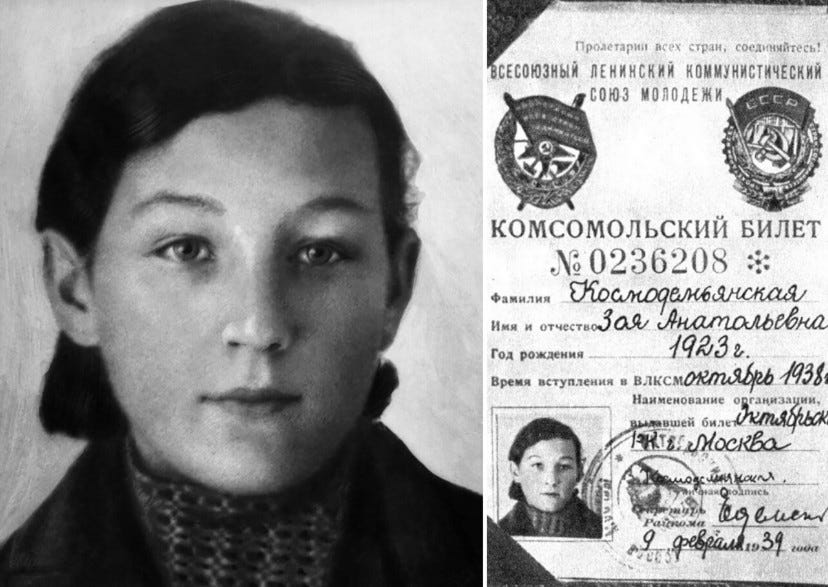
That sense of brave defiance is certainly something my Zoya inherited.
I met her in 1999 during a business trip to St. Petersburg. The firm I worked for had just opened its first Russian office and I was sent to get things set up with operations. I spent a month hiring and training the local administrative staff; then together we spent another two weeks finding local vendors we could trust for things like office paper, copier toner, computer equipment, phones etc. It involved a lot more than just opening the Yellow Pages, partly because there never was a Russian Yellow Pages and because in Russia every foreigner needs help to keep them from stepping into all kinds of cultural, economic and legal minefields. One of the best guides I found was a young man named Yaroslav Prokharov.
Slava was a 30-year-old 6’3” Muscovite who looked like a club boxer but was cheerful as a Walmart greeter and savvy as a concierge at the Ritz. He spoke fluent English and French, and seemed to have a connection or relative or good idea to solve nearly every problem I encountered. As the office opened successfully, I should have been taking him out to the fanciest restaurant I could find to thank him for all his help, but in typical Russian fashion, he insisted instead that I come to dinner at his home with his wife, Irina, and seven of his closest friends.
Irina was a lovely blonde-haired doctor who, at 28, was already a respected cardiologist. Their friends were an eclectic mix of creative people, scientists, and scoundrels whose main connection seemed to be time spent at university. I was sitting next to the one person in the room (besides me) who did not fit that description, and her name was Zoya.
She had lovely brown hair that curled in waves and shined like lacquered walnut. Her green/gray eyes were inquisitive and playful; full of jokes and mystery, and her smile was spritelike with a sense of wonder that most American women lose long before their 28th year. I adored her from that first evening. More than anything, I was grateful that she spoke lovely lilting English that I could follow with little effort.
For the past six weeks I had been immersed in a world of people who looked much like me but spoke and acted nothing like the Midwestern Americans I was used to. Most of what was said to me was translated, and although I grew to trust Slava and our other local staff, every conversation was like having a long detailed discussion over a bad telephone connection — slow, indistinct, and prone to misunderstanding — in a word, exhausting.
Talking with Zoya on that night was like drinking clean, cold water after a long walk through a dry land. Whatever misunderstandings we would develop later, on that night we communicated very clearly.
Zoya was Irina’s oldest and dearest childhood friend. They grew up together in a factory town in central Russia that was a ZATO — a closed city during Soviet times. No foreigners ever visited and residents needed a special permit to leave. Once the Cold War ended, much of the reason for secrecy ended too, but the place was still isolated and provincial.
Irina had gotten out through education. Both of her parents were doctors — her father was known for his research into eye diseases. With their constant tutoring and carefully fostered connections Irina’s place at Moscow University (think of it as Russia’s Harvard) was assured. She wanted the same for her best friend, but Zoya’s path was different. She came from more modest stock. Zoya’s father was a factory worker who was often drunk and abusive. Her mother sold ladies coats at the city’s only department store.
A smart girl hampered by a stubborn independent streak and indifferent teachers, Zoya ended up at the local university studying chemistry with the thought of some indistinct science career. In the years after graduation she bounced around from working in the Environmental Safety department (never a priority in Soviet times or since) of a local factory to helping manage a greenhouse growing flowers for local markets.
When we met she was in St. Petersburg on holiday. Irina and Slava were urging her to move there and escape the drear of her home city and, according to Zoya, she was seriously considering their offer of help in finding work and someplace to live. It was a manageable adventure. Before we met I don’t think Zoya had ever seriously considered leaving Russia.
For the final three days of my visit, we spent a great deal of time together. She was appalled that I had been in Russia for over a month and seen little outside the airport, my hotel, and our office.

She took me on a tour of the Hermitage and the palace of Catherine the Great in Tsarskoye Selo. We saw a ballet at the Mariinsky Theatre and an impressive concert by a popular Russian singer named Oleg Gazmanov. The finale of the show was Gazmanov performing with the entire Red Army Chorus. It was real Soviet-style spectacle and my Western eyes and ears loved every minute.
Zoya was impressed that I could enjoy Russian culture despite my decided lack of language skills. “Showing appreciation for something presented in a language you don’t understand speaks to the openness of your heart,” she said. “I can’t imagine all Americans are so cultured.” This was the beginning of Zoya’s illusion that I was exceptional in some way. She would eventually discover that her early impressions of me would run head first into my comfortable mediocrity.
Let me digress for a minute on mediocrity, because after looking back at the last sentence, I suspect dear reader you may be thinking I am either being too hard on myself or that I have lost my ambition, feel bad about it, and thus accuse myself of mediocrity to reveal my disappointment. Neither is true.
I stopped being my own worst critic when I was 32.
Until that time I truly did loathe most of whom and what I was and often felt that my existence on this Earth was pointless and futile. For years I’ve tried to understand and excise these feelings. I won’t bore you with the details since they involve mundane topics like incest, sexual abuse, adultery and madness.
Suffice it to say that my self loathing was very understandable given my parentage and upbringing. It led me to rush into a string of unfulfilling, abusive relationships with women who held me in just slightly more contempt than I did myself. I even married one — the most despotic of the lot. I could write a whole other journal detailing her shenanigans but suffice it to say she was, as my Grandma would say while rolling her eyes, “a real winner.”
When asked what her dream job would be, my dear first wife would answer in a consistent and unironic tone, “benevolent dictator.”
My role was always as her enabling lackey — Mussolini to her Hitler. I let her dictate everything. What we ate, where we lived, what my job was, who we visited and in what order on holidays. No matter what my own feelings were, all she had to do is draw a line in the dirt and challenge me to cross it.
I never did.
I always agreed, and not begrudgingly. I enthusiastically defended her orders. I embraced them as my own; thinking love between a man and woman must be built through loyalty and subservience since I had never seen it built through strength or mutual regard. In fact, I had never seen it built at all, in any way.
Even now, I do not hate my ex-wife. She only did what I let her do.
But I did hate someone, and my self-loathing made me want to destroy myself. However, in typical submissive fashion, I could only contrive to end my misery in the most passive and gentle way possible — I ate and ate and ate until I was more than 400 lbs. and could barely move without pain.
I knew I had hit bottom, or shall I say maximum density, when the Dictatrix (who was always slim and fit) wanted me to go on a 10-mile bike ride with some of her co-workers and their families. She hissed at me, jeering when I could not keep up after just one mile. “You’re embarrassing me,” she said venomously, “Even the grade school kids are faster than you. I should have never asked you to come. I don’t know why I try to include you in anything.”

I was in such physical and emotional pain that I broke down sobbing and tried to explain to her that I did not live in the blubbery shell that encased me, but only in my mind, which supposedly ran free and fast to all manner of places. Lines like that work swell in romance novels and Lifetime movies for women, but in reality you have to accept the fact that your intellect can’t get you up five flights of stairs when the elevator is broken, and neither could my body.
She just laughed at me scornfully and said, “Go home Scott. When your mind gets there, have it cook dinner.”
Each night I prayed for a heart attack or a stroke until finally I stopped praying, figuring any God that existed knew my desire and had obviously chosen to ignore it.
My younger sister was the one who helped me change directions. Dottie was always so fearless. She would never shrink from telling anyone what she thought or what she wanted. It got her kicked out of Brownies in the 4th grade but as an adult it was a useful tool most of the time.
If I ever wanted the unvarnished truth, or even if I didn’t, Dottie would provide it.
It was Christmas 1996 and after the dinner and all the goodbyes to cousins and aunts, she and I stayed up late into the night talking about life and our family and how crazy and sad our childhood had been. We were laughing about the time I managed to get our older sister Lila arrested because of a high school drinking party I had organized. When a lull reached the conversation I sat shaking my head, thinking of how irresponsible I had been and how much fun it all was. Dottie looked at me seriously for a few seconds and said, “You know she’s going to kill you, right?”
Not understanding her meaning I said, “Who? Lila? I think if she was going to kill me she would have done so right after Mr. Vetrano bailed her out of jail. Don’t you?”
“No, idiot — not our psychotic sister — I’m talking about your wife, Josefina Stalin. She will never be happy, but the one thing that might put a smile on her face for just a few moments would be the thought of playing the long-suffering widow for the rest of her life. You’re doing everything you can to help her land the role … why?”
At first I scoffed at her. I even tried to defend my wife but Dottie refused to be anything less than honest with me, even though she saw how much I did not want to face the truth.
She loved me that much.
We talked for a few more hours, and over the next two months a tiny seed of strength grew within me. Despite the fact that I have hated the medical profession and its medieval practices for nearly all my life, I went to see a doctor — several doctors. Thankfully, most of them were kind and he listened to my fears and problems, treating me like more than just a specimen to be examined. One sent me to a surgeon who specialized in a procedure that might help me.
The Dictatrix encouraged me to have the operation. I think she was secretly hoping I would die in the operating room and she would be able to sue the hospital for millions.
I tried to oblige her during the operation and again in the recovery room (I have the foot long scar to prove it).
Apparently anesthetics have a much stronger effect than normal on many people in my family. My grandmother was once sent into a weeklong hallucinatory break by a mild sedative. Gauging my massive girth, the anesthesiologist must have prescribed a horse-size dose. Imagine his shock when he knocked me out for surgery and my respiration and heart rate plunged to nothing 10 minutes into the operation.
I later learned the OR team took extraordinary efforts to revive me. However, someone forgot to tell the recovery room nurse, who overdosed me again on pain medication and sent my vitals plummeting one more time just as I was supposed to be coming around.
With those two episodes behind me, only some post-operative bleeding and a minor wound infection lay between me and recovery. Dottie and my Mother stayed with me, nursing me back to health the whole time because my wife refused to take any time away from work. She was gunning for a big promotion and thought it best not to miss a day.
“I can’t do anything here for you,” she said, and walked out the door.
I could no longer defend her. With a suppurating wound in my belly I didn’t have the strength or the desire, but slowly my stamina returned. Despite the blood, pus and pain, I almost immediately began to feel better — not just better than being at death’s door on a hospital gurney — but better than I had before I went into surgery. I had no desire to eat, partly because of the pain and partly because I had finally made a decision for myself, and then I made another and another.
It was starting to become habit.
As a result, the pounds melted off, quickly at first, then slower, then faster again as I was able to move a bit more. Exactly one year later I had changed everything. I was nearly 200 lbs. lighter (still large but manageable), and living back in my home town with a new job.
I was also newly single, having told my wife that it was over about six months into my recovery. She did not take it well.
Her last words to me were consistent with her oft-stated life ambitions.
“I want you to bleed. I want you to hurt. I want you to die,” she shouted at me, then slammed the door and drove away.
Funny thing was, for the first time in a long time, I very much wanted to live.
So I did.
(stay tuned for the next installment)